
#15: Silent Lambs: Unnamed sources of Giovanni Battista Casali
Emily Lara Grabo
Version of the article suitable for citation
on ART-Dok (Heidelberg University Library)
DOI: https://doi.org/10.11588/artdok.00010040
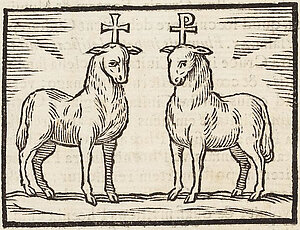
The Roman cleric, antiquarian and collector of antiquities Giovanni Battista Casali (1578–1648) [1] discusses a wide variety of depictions of crosses and cross-like forms in his treatise on Christian rites within his three-volume work “De profanis et sacris veteribus ritibus”, including notable depictions showing the connection between the cross and the agnus dei (Fig. 1).
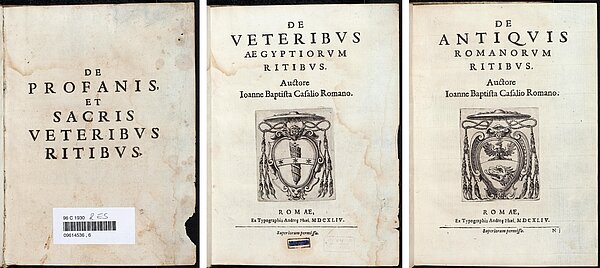
This major work by Casali, who also gained fame and recognition for his study of Roman topography and antiquities, “De Urbis ac Romani olim Imperii splendore” (1650) and in particular its third part, had a lively publication history: The first two treatises, “De veteribus AEgyptiorum ritibus” and “De antiquis Romanorum ritibus”, were published in 1644 by Andrea Fei (1579–1650) in Rome under the title “De profanis et sacris veteribus ritibus” (Fig. 2, ThesaurusID 1479344). [3]
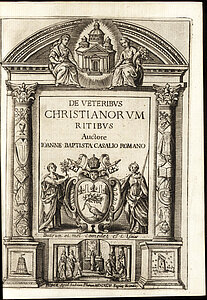
A year later, Casali submitted to the same publisher the considerably more extensive treatise on Christian rites “De veteribus Christianorum ritibus”, which had already been announced in the preface “Ad Lectorem” in 1644 (Fig. 3, ThesaurusID 23881295). [4]
In order to distribute the volumes, which were unaltered from the Roman edition, in France via the Parisian bookseller Siméon Piget (active 1639–1668), all three treatises were published together in 1646 under the new collective title “Sacrae prophanaeque religionis vetustiora monumenta” and with a new additional title page (Fig. 4). [5]

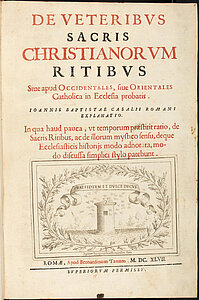
As his previously published “fragment of early Christian rites [... contained] numerous errors regarding authorship and printing” [6] Casali had an expanded version of the Christian rites published in Rome just one year later, in 1647, this time by Bernardino Tani (active 1637–1649) (Fig. 5, ThesaurusID 23881420).
The revisions and additions concern both the text and the illustrations: four new woodcut illustrations depicting further cross forms have been added (ThesaurusID 23881457, ThesaurusID 23881458, ThesaurusID 23881459, ThesaurusID 23881460) as well as a copper engraving depicting the so-called rain miracle on the Column of Marcus Aurelius (ThesaurusID 23881448).
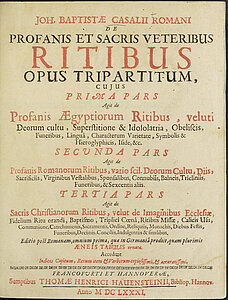
Finally, following Casali’s death (1648), this revised treatise on Christian rites was published once again as a three-part work under the title “De profanis et sacris veteribus ritibus opus tripartitum”, together with “De veteribus AEgyptiorum ritibus” and “De antiquis Romanorum ritibus”, by Thomas Heinrich Hauenstein in Frankfurt and Hanover in 1681 (Fig. 6, ThesaurusID 1369099). For this, Hauenstein had all the illustrations re-engraved on copper plates.
As with “De profanis et sacris veteribus ritibus”, Casali largely draws on artefacts from his own collection to illustrate Christian rites. [7] These include an enkolpion (ThesaurusID 23983040), a pilgrim’s badge (ThesaurusID 24007200) and a pendant (ThesaurusID 24007204) each in the shape of a cross. Most of the remaining depictions of crosses are derived from Giacomo Bosio’s (1544–1627) [8] historical-theological reflection on the cross and its symbols, “La trionfante e gloriosa croce” (ThesaurusID 1737418), which had been published 35 and 37 years earlier respectively. However, in most cases Casali does not explicitly cite Bosio as the source. [9] For instance, in 1647 Casali adopts Bosio’s illustration of two lambs with a cross and a Christogram without naming him. Even though the woodcutter working for Casali eliminates the surrounding landscape in his depiction, the copied original remains recognisable (Fig. 7 and Fig. 8, ThesaurusID 23875122, ThesaurusID 23881459).
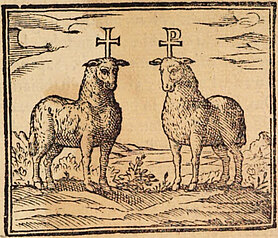
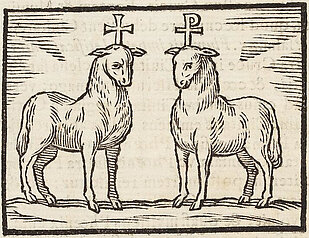
The text accompanying the illustration states that the lambs are depicted in ancient marble monuments. [10] However, in both Casali’s and Bosio’s works, the illustration serves to illustrate lambs crowned with a cross or Christogram as a visual element of Christian monuments, rather than to depict a specific artefact: Bosio states that such lambs crowned with a cross or Christogram can be seen on Christian sarcophagi found in Rome. [11] Although the major 17th-century work on Christian archaeology, “Roma Sotterranea”, by his nephew Antonio Bosio (1576–1629), was only published posthumously in 1632/34, [12] it can nevertheless be considered a reference for Bosio. For work on it had already been ongoing for several decades since the end of the 16th century: by 1615, some of the plates for the planned work were reportedly already printed. [13] Even Giacomo Bosio himself refers to his nephew’s work and book as early as 1610: “E di essi fà particolar mentione Antonio Bosio mio Nepote, nel suo Libro deʼ Sacri Cemiterij, intitolato Roma Subterranea.” [14]
Antonio Bosio’s publication contains only three sarcophagi featuring such lambs: one with a Christogram and two with a simple cross. All three sarcophagi have survived, are still located in Rome, and have been included in the repertory of early Christian sarcophagi [15]: The columnar sarcophagus, which depicts a lamb with a Christogram alongside Christ on its front, is now in the Basilica of San Pietro in Vaticano (Fig. 9), [16] whilst the columnar sarcophagus featuring the agnus dei crowned by a cross is now kept in the Papal Basilica of San Paolo fuori le mura (Fig. 10). [17]
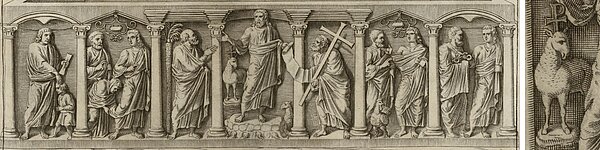
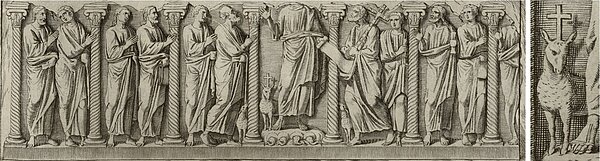
The front of the second sarcophagus, featuring a lamb surmounted by a cross, is in turn part of the collection of the Museo Pio Cristiano of the Musei Vaticani, albeit in a fragmented state (Fig. 11). [18]
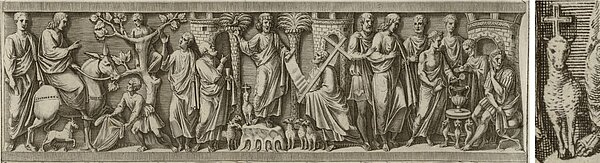
In all three cases, the lambs face the viewer much more directly than in the woodcut in “La trionfante e gloriosa croce”. This suggests that, despite referring to the sarcophagi featured in both “Roma Sotteranea” in 1610 and the “Repertorium”, Giacomo Bosio did not simply mimic the depiction of the lambs on the sarcophagi.
When discussing crosses in early Christian mosaics in 1645, Casali also draws on visual material previously published by Bosio. This is the case, for instance, with the detail featuring a gemstone cross and a lamb from the apse mosaic of Old St Peter’s (Fig. 12 and Fig. 13), which by that time had already been lost for 53 years in the course of the construction of the new basilica. [19]
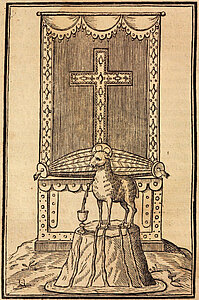

In his work, Bosio states that he is in possession of a copy of a drawing of the tribuna of Old St Peter’s, which was commissioned by the canons of St Peter’s prior to the destruction of the apse and whose fidelity to the original was certified by a notary. [20] He can only be referring to the watercolour pen-and-ink drawing now found in the so-called Grimaldi Album. [21] The parchment contains, beneath the drawing of the mosaic, a description and a certification by the Capitoline notary Quintiliano Gargario dated 3 August 1592.
In her 2004 essay, Antonella Ballardini traces the genesis of this drawing and its subsequent circulation in manuscripts, and classifies all known copies into a stemma based on their relationships.[22] According to this, there are only three copies that were produced before 1610, the year Bosio’s book was published, and which could therefore be considered as Bosio’s source. [23] Two are found in an album belonging to Alfonso Chacón (1540–1599) [24] and, like the third copy [25] – which, according to Ballardini, is also linked to Chacón – can therefore be dated to before his death in 1599. This third copy, now in the possession of the Biblioteca Angelica, is a collage. In the drawing on fol. 31v–32r in Vat. lat. 5408 from Chacón’s collection, Ballardini sees a copy of that collage by the same artist. Whilst the highly simplified depiction of the lamb rules out the Angelica collage and its copy as a model for Bosio, the similarities between the drawing authenticated by Gargario in the Grimaldi Album and its copy on fol. 29v–30r in Vat. lat. 5408 from Chacón’s collection make it difficult to reach a definitive conclusion (Fig. 14). One striking difference remains the streams of blood flowing from the lamb’s feet, which are depicted in detail in the authenticated drawing of 1592 and in Bosio’s woodcut, whilst they are merely hinted at in Chacón’s copy.
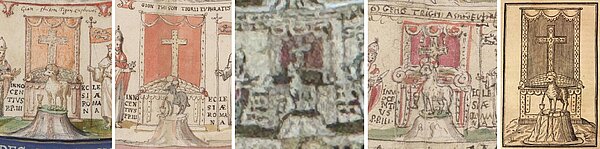
The possibility that Bosio possessed another copy of the certified record of the apse mosaic – one that is no longer extant or known today – and used it as a model therefore remains a possibility, given the greater level of detail evident in both Bosio’s woodcut and the 1592 drawing in the Grimaldi Album.
No earlier printed illustration of the apse of Old St Peter’s has been found so far that predates Antonio Bosio’s detail from 1610. In 1693, Giovanni Giustino Ciampini (1633–1698) included a copperplate engraving based on the 1592 drawing as well as the notarial certification in his work on church buildings from the time of Emperor Constantine (c. 280–337) (Fig. 15). [26]
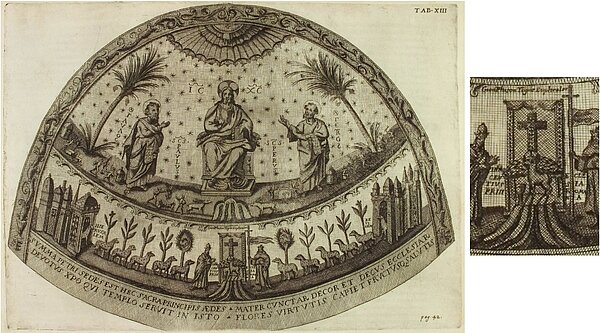
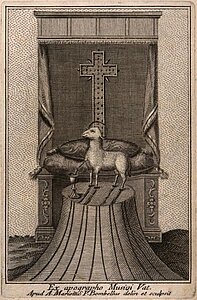
It was not until 1767 that Agostino Mariotti (1724–1819) republished the same detail chosen by Bosio, depicting the lamb of God before the cross, out of dissatisfaction with Ciampini’s engraved reproduction, which in Mariotti’s view failed to capture such important details as the blood flowing into the chalice (Fig. 16). [27]
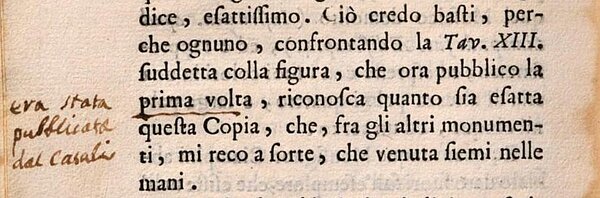
The basis for his illustration was a copy of the apse mosaic from his own collection, which differed in numerous details—such as the shape of the canopy and the number of cushions on the throne—from Ciampini’s print and its original. [28] According to José Ruysschaert, Mariotti’s model is a painting from the first half of the 17th century, now in the Museo Cristiano of the Vatican Museums, which, together with a drawing from the Museo Cartaceo by Cassiano del Pozzo (1588–1657), belongs to a second tradition of depictions of the apse mosaic of Old St. Peter based on an unknown drawing. [29] Apparently unfamiliar with neither the authenticated drawing in the Grimaldi Album and its copies nor with the prints by Bosio and Casali, Mariotti states of his illustration: “[…] che ora pubblico la prima volta”. [30] An attentive reader, well-versed in the reception history of the apse mosaic of Old St Peter’s, has written next to this passage in a copy held at the Biblioteca Nazionale Centrale in Florence: “era stata pubblicata dal Casali” (Fig. 17). [31]
[1] For information on Casali, see Dizionario biografico degli italiani, vol. 21, Rome 1978, pp. 88–89 (Nicola Parise) and Ingo Herklotz: Cassiano Dal Pozzo und die Archäologie des 17. Jahrhunderts, Munich 1999, pp. 175–179.
[2] Herklotz counts it among “the finest achievements that Roman classical studies produced outside the field of numismatic research during the first half of the 17th century.” (Herklotz 1999, p. 175).
[3] The two volumes comprise a total of 296 pages, 17 copperplate engravings and 30 woodcut illustrations. Although it has not been possible to examine all copies systematically, the available digitised versions indicate that the treatises are generally paginated throughout and have been preserved as a single bound volume. See, for example, the copy held by Heidelberg University Library, 96 C 1930 RES, catalogue entry: https://katalog.ub.uni-heidelberg.de/titel/66962173 (last accessed on 17 February 2026).
[4] The volume comprises 496 pages, 6 copper plates and 8 woodcut illustrations. Although it has not been possible to examine all copies systematically, the available digitised versions indicate that the treatise is generally bound together with Casali 1644 but is always paginated separately. See, for example, the copy held by the Getty Research Institute, Los Angeles, 92-B22794, catalogue entry: http://primo.getty.edu/GRI:GETTY_ALMA21139902230001551 (last accessed on 17 February 2026).
[5] See, for example, the copy held by the Bibliothèque municipale, Lyon, 317193, catalogue entry: https://catalogue.bm-lyon.fr/ark:/75584/pf0000876205 (last accessed on 17 February 2026).
[6] Giovanni Battista Casali: De veteribus sacris christianorum ritibus, sive apud Occidentales, sive Orientales catholica in Ecclesia probatis, Ioannis Baptistae Casalii Romani explanatio, Rome 1647, p. [3] (translation by the author).
[7] Of the 27 artefacts illustrated in the 1647 edition, 15 come from Casali’s collection.
[8] Giacomo Bosio and his collection of antiquities were already the subject of the blog post “#7: From Pirro Ligorio to Bernard de Montfaucon – Four lines of graphic transmission for the block statue of Petamenophis” by Cristina Ruggero and Timo Strauch; see also: https://doi.org/10.11588/artdok.00009823 (last accessed on 17 February 2026).
[9] Exceptions are the illustration of the detail featuring sacrificial figures from the Mensa Isiaca (Casali 1647, p. 9, ThesaurusID 23881326) and the detail featuring an owl from the Lateran Obelisk (Casali 1647, p. 11, ThesaurusID 23881327).
[11] Giacomo Bosio: La trionfante e gloriosa croce, trattato di Iacomo Bosio. Lettione varia, e divote; ad ogni buon Christiano utile e gioconda, Rome 1610, p. 697.
[12] Michael Thimann: „Das unterirdische Rom als Bildraum. Zur Roma sotterranea des Antonio Bosio (1632/34)“, in: Ulrike Feist (ed.): Et in imagine ego. Facetten von Bildakt und Verkörperung. Festgabe für Horst Bredekamp, Berlin 2012, pp. 395–421, here p. 397. For a detailed discussion of Antonio Bosio’s background and the history of the editing and publication of his work “Roma sotteranea” see Chiara Cecalupo: Antonio Bosio, la „Roma sotterranea“ e i primi collezionisti di antichità cristiane, 2 vols., Vatican City 2020.
[13] Thimann 2012, p. 402.
[15] Friedrich Wilhelm Deichmann (ed.): Repertorium der christlich-antiken Sarkophage. vol. 1: Rom und Ostia, with contributions by Giuseppe Bovini and Hugo Brandenburg, 2 vols., Wiesbaden 1967.
[16] Antonio Bosio: Roma sotterranea, opera postuma di Antonio Bosio romano, antiquario ecclesiastico singolare de' suoi tempi. Compita, disposta, & accresciuta dal M. R. P. Giovanni Severani da S. Severino, Rome 1632, p. 61 corresponds to Deichmann 1967, vol. 1, pp. 273–274, no. 676.
[17] Bosio 1632, p. 157 corresponds to Deichmann 1967, vol. 1, pp. 298–299, no. 724.
[18] Bosio 1632, p. 63 corresponds to Deichmann 1967, vol. 1, pp. 24–26, no. 28.
[19] The decision to demolish the apse and the tegurium built by Bramante to protect the high altar was taken by Clement VIII on 3 July 1592; the demolition probably took place in September of the same year; Antonella Ballardini: „La distruzione dell'abside dell'antico San Pietro e la tradizione iconografica del mosaico innocenziano tra la fine del sec. XVI e il sec. XVII“, in: Miscellanea Bibliothecae Apostolicae Vaticanae 11 (2004), pp. 7–80, here pp. 7–9.
[21] Vatican City, Biblioteca Apostolica Vaticana, Arch. Cap. S. Pietro A. 64.ter, fol. 50r.
[22] Ballardini 2004, pp. 7–80, the stemma on p. 26; see also ead.: “Alle origini dell’Album del Grimaldi (Arch. Cap. S. Pietro A. 64ter). Il liber picturarum di Domenico Tasselli e altri disegni dell'antico San Pietro”, in: The Vatican Library Review 1 (2022), pp. 53–90, here the same stemma on p. 61.
[23] Ballardini 2004, pp. 46–47, no. 4, pp. 60–61, no. 9, pp. 62–63, no. 10.
[24] Vatican City, Biblioteca Apostolica Vaticana, Vat. lat. 5408, fol. 29v–30r, fol. 31v–32r.
[25] Rome, Biblioteca Angelica, C. 2.11, fol. 18 (illustrated in Ballardini 2004, p. 61, pl. 22).
[26] Giovanni Giustino Ciampini: De Sacris Ædificiis a Constantino Magno constructis. Synopsis Historica, Rome 1693, pp. 42–48, pl. XIII.
[27] Agostino Mariotti (ed.): Delle virtù mostrateci nella passione dal nostro signor Gesù Cristo orazione di fr. Aurelio Brandolino agostiniano detta l'anno della fruttifera Incarnazione MCCCCXCVI nella Cappella Pontificia, [...] novellamente recata di latino in lingua Italiana dall'avvocato Agostino Mariotti romano a riscontro del testo. [...] Alla santità di nostro signore papa Clemente XIII, Rome 1767, p. 10.
[28] Ibid.
[29] José Ruysschaert: „Le tableau Mariotti de la Mosaïque Absidale de l'Ancien S.-Pierre“, in: Rendiconti. Atti della Pontificia Accademia Romana di Archeologia, Series III, 40 (1967/68), pp. 295–317, here p. 300–308. The Dal Pozzo drawing is sheet RL 8966 in Windsor Castle; see John Osborne, Amanda Claridge: Early Christian and Medieval Antiquities, 2 vols., London 1996–98 (The Paper Museum of Cassiano Dal Pozzo, Series A, Part 2), vol. 2 (1998), pp. 76–77, cat. no. 177.
[30] Mariotti 1767, p. 10.
[31] Copy held at the Biblioteca Nazionale Centrale, Florence, V.MIS 1120.16, catalogue entry: https://opac.bncf.firenze.sbn.it/Record/RAVE032673 or digital copy: https://books.google.de/books?id=3kTBksJ7zNYC (last accessed on 17 February 2026).
Berlin-Brandenburg Academy of Sciences and Humanities
Antiquitatum Thesaurus: Antiquities in European Visual Sources from the Seventeenth and Eighteenth Centuries


© 2018-2026